

 Automation
 AI Integration
 Custom Business Systems
 Web Development & Hosting
 Resource Hub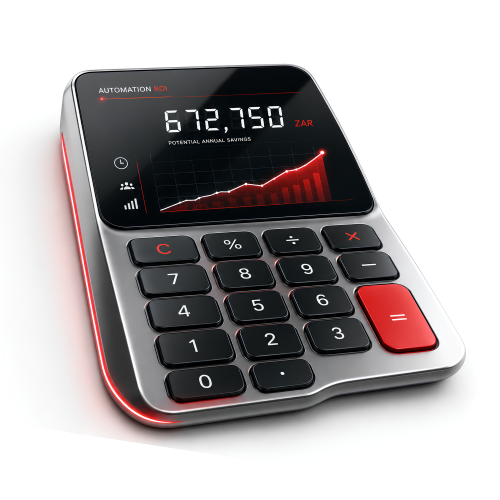
Interactive calculator
Manual Admin Cost and Automation ROI Calculator
Calculate what a repetitive manual process is currently costing your business. You can then optionally add a proposed automation scenario to estimate potential savings, break-even and return on investment.
Your Current Manual Process
Enter information about how the process operates today. These fields relate only to the current manual work performed by your employees.
Count the employees who regularly capture, check, correct, approve, follow up or report on this process.
Include data capture, checking, corrections, follow-ups, approvals and report preparation.
Use the approximate hourly cost of employing the people involved, including salary and reasonable employment overheads.
Estimate the additional effort caused by incorrect information, duplicated work, missing details and corrections.
What the Manual Process Is Costing You
These figures describe the cost of the current manual process before any automation system is considered.
3 900 hours
R 585 000
R 87 750
R 672 750
The estimated labour cost represents the value of employee time used by the process. It does not automatically represent cash that can be removed from payroll.
Optional Automation Scenario
Only complete this section if you want to compare the current manual process with a possible automation solution.
Include an automation ROI estimate
Leave this off if you only want to calculate what the current manual process is costing your business.
They do not refer to your existing employee wages or the current cost of performing the process manually.
Automation rarely removes the entire task. Estimate the human involvement that will remain for reviews, exceptions, approvals and decisions. A value of 40% means approximately 60% of the current manual workload could potentially be recovered.
Include process design, development, configuration, testing, training and implementation. Leave this blank if you do not yet have an estimate.
Include software licences, hosting, maintenance and ongoing technical support. This is the cost of the proposed automation system, not the cost of your employees.
Estimated Impact of the Proposed Automation
These estimates compare the current manual process with the automation scenario entered above.
1 560 hours
2 340 hours
R 403 650
Add system costs
Add system costs
Add system costs
Add system costs
You can still use the hours-recovered and gross-benefit estimates before you have received a formal system quotation.
These figures are estimates for initial business-case planning. Actual savings will depend on process design, adoption, exceptions, implementation quality and operating conditions.
Save Your Results
The download will include the current manual-process calculation and the automation scenario if you have enabled it.
Methodology
How the Calculator Works
The calculator first estimates the time and financial cost of the current manual process. The automation scenario is optional and is calculated separately.
Annual manual working hours
Employees involved × manual hours per employee each week × 52 weeks.
Annual manual labour cost
Annual manual working hours × estimated hourly employment cost.
Estimated annual rework cost
Annual manual labour cost × estimated rework and error rate.
Total annual manual process cost
Annual manual labour cost + estimated annual rework cost.
Remaining manual effort
Annual manual working hours × the percentage of the task that will still require human effort after automation.
Hours potentially recovered
Current annual manual working hours − the estimated manual hours remaining after automation.
Estimated annual gross benefit
Total annual manual process cost × the percentage of the current workload potentially recovered.
First-year net saving
Annual gross benefit − the one-off implementation cost − twelve months of automation system costs.
Three-year net saving
Three years of gross benefit − the one-off implementation cost − 36 months of automation system costs.
Break-even period
One-off implementation cost ÷ the estimated monthly gross benefit after monthly automation system costs.
Estimated first-year ROI
First-year net saving ÷ total first-year automation investment, expressed as a percentage.
The calculator estimates the value of employee time that may be recovered. That value is only realised when the recovered time is redirected toward productive work, additional capacity, improved service, lower overtime or another measurable business outcome.
Worked example
A 15-Person Operations Team Processing Weekly Reports
Employees involved
Per employee each week
Estimated hourly employment cost
Estimated rework rate
This process consumes approximately 3 900 working hours per year. At an estimated employment cost of R150 per hour, the base manual labour cost is approximately R585 000 per year.
After adding an estimated 15% for errors and rework, the total estimated cost of the manual process is approximately R672 750 per year. The business can stop at this point if it only wants to understand its current cost.
To assess a possible automation system, the business can then estimate how much human effort will remain and enter any available implementation, software, hosting and support costs.
Interpretation
What the Results Mean
Manual process cost is not automatically cash saved
Recovered employee time only becomes financial value when it is redirected toward productive work, additional capacity, improved service, reduced overtime or avoided future hiring.
You can use the calculator without an automation quote
The first section works independently. You do not need implementation or monthly system-cost figures to calculate what the current manual process is costing.
Use conservative assumptions
Do not assume that all manual work will disappear. Reviews, approvals, unusual cases, customer interactions and management decisions often still require human involvement.
Gross benefit is not the same as net saving
Gross benefit estimates the value of the work potentially recovered. Net saving also accounts for implementation, software, hosting, support and other automation system costs.
A longer break-even period is not automatically negative
Automation may also improve consistency, visibility, compliance, customer service and decision-making even where the direct financial return takes longer to recover.
Start with the process, not the technology
Confirm the current workflow, volumes, bottlenecks, error rates, exceptions and business requirements before selecting an automation platform or development approach.