

 Automation
 AI Integration
 Custom Business Systems
 Web Development & Hosting
 Resource Hub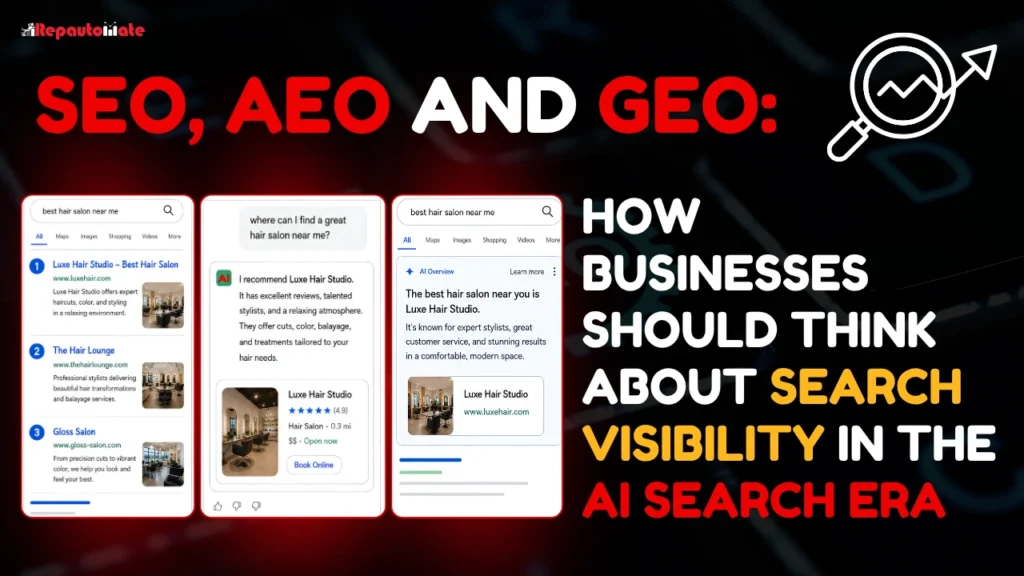
For years, online discovery followed a fairly predictable path. Someone searched on Google, clicked a website, compared a few options, and then made contact.
That path still matters, but it is no longer the only way people find and evaluate businesses. Today, a potential customer may ask Google, ChatGPT, Gemini, Perplexity, or another AI-powered tool for advice before they ever visit a website. They may ask for a recommendation, a comparison, a checklist, a solution to a specific problem, or a summary of what to consider before choosing a provider.
That changes how businesses should think about visibility. The question is no longer only, “Do we rank on Google?” A better question is, “When someone asks a serious question related to what we do, are we visible, credible, and useful enough to be considered?”
That is where SEO, AEO and GEO come in.
Prefer to watch or listen?
Get a comprehensive overview of the article’s key insights by playing our summary video.
Disclaimer: This video is an automated summary generated using NotebookLM by Google based on the original article text. While it provides an accurate overview of the key themes, please refer to the full original article for complete details and context.
SEO is not dead, but the way people search is changing
There is a lot of noise online suggesting that AI search has replaced SEO. That is misleading.
For Google specifically, AI Overviews and AI Mode are still connected to Google Search systems. Google’s own guidance is clear that its generative AI search features are built on its existing search ranking, indexing and quality systems. In simple terms, strong SEO foundations still matter.
What has changed is not that SEO has disappeared. What has changed is that search is becoming more answer-led, more conversational, and more selective in what it surfaces.
A page can rank. A page can be clicked. A page can be used as a supporting source. A brand can be mentioned or considered without the user immediately visiting the website. These are related outcomes, but they are not exactly the same.
That is why businesses need to think beyond rankings alone.
What SEO, AEO and GEO actually mean
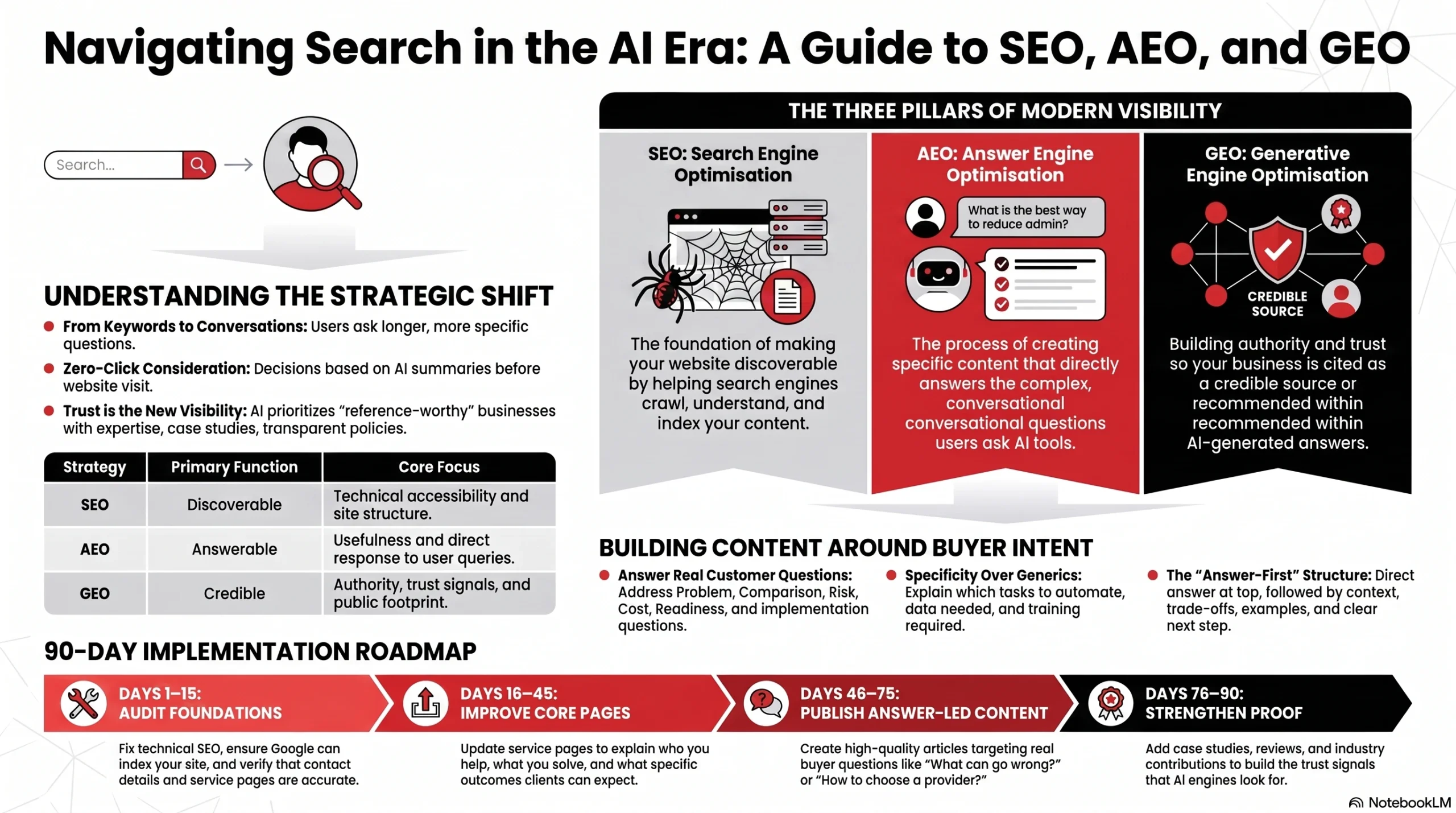
The terms are useful, but only if they are understood correctly.| Term | What it means | Main goal |
|---|---|---|
| SEO | Search Engine Optimisation | Help search engines crawl, understand, index and rank your website |
| AEO | Answer Engine Optimisation | Create content that clearly answers the questions people are asking |
| GEO | Generative Engine Optimisation | Build enough authority, clarity and trust to be referenced or considered by AI-generated answers |
These should not be treated as three completely separate strategies. A practical way to understand them is this: SEO makes your content discoverable, AEO makes your content answerable, and GEO makes your business credible enough to be referenced.
The strongest long-term approach is to build all three on the same foundation: useful content, clear expertise, technical accessibility, accurate information, and genuine trust signals.
Why this matters now
AI search is changing user behaviour in a few important ways.
First, people are asking longer and more specific questions. Instead of searching “business automation software”, they may ask, “What is the best way for a South African business to reduce manual admin without replacing staff?”
Second, people are expecting direct answers. They do not always want a list of links. They often want a useful explanation, a shortlist, a comparison, or a recommended next step.
Third, users may form an opinion before they ever click through to your website. If an AI-generated answer helps them understand the options, risks and providers in a market, then the businesses referenced or recognised in that answer may earn attention earlier in the decision process.
This does not mean every search becomes zero-click. It does mean your website is no longer the only place where your credibility is evaluated.
What businesses should do differently
The practical answer is not to chase every new AI-search tactic. The practical answer is to make your business easier to understand, easier to verify, and easier to trust.
That starts with your website.
Before publishing more articles, check whether your website clearly explains who you help, what problems you solve, what services or products you offer, where you operate, what outcomes you help clients achieve, how someone can contact you, why your business is credible, and what proof supports your claims.
For a service business, each main service should ideally have its own clear page. A vague “Services” page that lists everything in broad terms is usually weaker than dedicated pages that explain each service properly.
For example, instead of only saying “We provide automation solutions”, a business should explain what types of tasks can be improved, what the process looks like, what the client needs to prepare, what outcomes are realistic, what limitations exist, and when the solution may not be suitable.
This helps humans first. It also helps search engines and AI systems understand what your business is actually relevant for.
Build content around real buyer questions
AEO is not about writing short FAQ spam. It is about identifying the questions your customers already ask before they are ready to buy, and then answering those questions properly.
Useful question categories include:
- Problem questions, such as “Why is our reporting process taking so long?”
- Comparison questions, such as “Should we use off-the-shelf software or build a custom system?”
- Risk questions, such as “What can go wrong when automating business processes?”
- Cost questions, such as “What affects the cost of a custom business system?”
- Readiness questions, such as “How do we know if a process is ready to automate?”
- Implementation questions, such as “What should we prepare before starting an automation project?”
- Trust questions, such as “How do we choose the right provider?”
The best content does not just answer the question in one paragraph. It explains the context, trade-offs, mistakes to avoid, practical examples, decision factors and next steps.
A strong structure is simple: give a direct answer near the top, explain when that answer applies, explain when it does not apply, provide a practical example, list the decision factors, and give the reader a sensible next step.
This makes the content useful to a human reader and easier for answer-led systems to interpret.
Create content that is not generic
Generic content is becoming less valuable. If an article only repeats what dozens of other websites already say, there is little reason for a search engine, AI system, or potential customer to prefer it.
Stronger content includes information that comes from real experience. This could include implementation lessons, common mistakes, pricing considerations, client readiness checklists, before-and-after process examples, practical templates, decision frameworks, industry-specific examples, limitations and risks.
For example, a generic article might say, “Automation saves time and improves efficiency.”
A stronger article would explain which tasks are usually suitable for automation, which tasks should stay human-led, what data needs to be clean first, what approvals are needed, how to measure time saved, what staff training is required, and what maintenance is needed after launch.
That second version is more useful because it helps the reader make a better decision.
Treat trust as part of visibility
Search visibility is no longer only about keywords and pages. Trust signals matter because users, search engines and AI systems all need ways to evaluate whether a business is credible.
Practical trust signals include detailed case studies, clear service pages, genuine reviews, testimonials with context, accurate business information, consistent contact details, transparent policies, useful articles, relevant industry contributions, examples of past work, and clear explanations of your process.
This does not mean fabricating authority or chasing fake mentions. Inauthentic mentions, fake reviews and low-quality directory spam are risky and short-sighted.
The better long-term approach is to become genuinely reference-worthy.
Practical SEO actions (that still matter)
Technical SEO still matters because search engines and AI-powered search features cannot use what they cannot properly access, understand or index.
At minimum, businesses should make sure that important pages can be crawled and indexed, Google Search Console is set up, page titles and meta descriptions are clear, each main page has a clear topic, headings are logical, internal links connect related pages, service pages are not hidden behind unnecessary barriers, the website works properly on mobile, contact details are easy to find, and old or inaccurate pages are updated or removed.
Images should have sensible file names and alt text where useful. Structured data can also help search engines understand a page, but it is not a magic AI visibility shortcut. It should be accurate, relevant, and aligned with the visible content on the page.
Useful structured data may include Organization, LocalBusiness, Service, Product, Article, BlogPosting, BreadcrumbList, and other relevant types depending on the page. The key rule is simple: do not mark up anything that is misleading, hidden, fake, or unrelated to the page.
Practical AEO actions
To improve answer-led visibility, start by listing the questions customers ask before buying. Use sales calls, email enquiries, consultation notes, customer support questions, Google Search Console queries, Google “People also ask”, LinkedIn comments, competitor FAQs, and internal staff knowledge.
Do not start with keyword tools only. Start with real customer confusion.
Once you have the questions, group them by intent. Some users are learning. Some are comparing options. Some are checking risk. Some are evaluating cost. Some are ready to choose a provider. These groups should not all be treated the same.
Then create answer-first content. If the question is, “Should a business choose off-the-shelf software or a custom system?”, the article should answer directly before expanding.
A practical direct answer might be: “Off-the-shelf software is usually better when the business can adapt to the tool. A custom system is usually better when the process is unique, central to operations, or difficult to manage properly with standard tools.”
After that, the article can explain the trade-offs, costs, risks, examples and decision criteria.
Finally, keep important content maintained. If the topic changes regularly, add a review date and update the content when needed. This is especially important for articles about AI tools, data compliance, search behaviour, software platforms, pricing or regulations.
Outdated content weakens trust.
Practical GEO actions
GEO is the least mature and most uncertain of the three terms, so it should be handled carefully.
No business can guarantee that ChatGPT, Gemini, Perplexity or any other AI system will cite or recommend it. AI-generated answers vary by platform, query, location, timing, user context and available sources.
What businesses can do is improve the likelihood that they are understood and considered credible.
Start by strengthening your public footprint. Your website matters, but it is not the only place where your business can be understood. Accurate and consistent information across your website, Google Business Profile, LinkedIn company page, reputable directories, partner pages, industry articles, review platforms, case studies and public profiles can all help build a clearer picture of your business.
The goal is not to spam the web with your business name. The goal is to make your expertise visible in legitimate places.
Next, publish evidence instead of only making claims. “We help businesses save time” is weak on its own. A stronger explanation would be: “We help businesses reduce repetitive admin by mapping manual workflows, identifying repeatable steps, and building systems that automate reporting, approvals, reminders, document generation or data capture where appropriate.”
Even better is a case study showing the problem, process, solution, outcome and limitations.
Finally, be specific about what you do and do not do. Broad labels like “automation”, “AI” and “digital transformation” are not enough on their own. Explain the actual use cases, such as automated monthly reports, client onboarding workflows, quote and invoice generation, staff task tracking, custom dashboards, data capture forms, approval workflows, AI policy development, staff training, and internal knowledge assistants.
Specificity helps people understand you. It also gives search and AI systems clearer context.
What not to waste time on
Because AI search is changing quickly, many tactics are being sold with more confidence than evidence.
Be careful with any advice that claims a guaranteed way to appear in AI-generated answers. Avoid publishing large volumes of generic AI-written content, creating pages for every tiny keyword variation, adding fake FAQs, using misleading structured data, chasing fake mentions, buying low-quality directory placements, rewriting your whole website only for AI bots, or hiding important content from users while showing it to crawlers.
Also be cautious about treating new AI-specific files, markup or formatting tricks as guaranteed visibility shortcuts. For Google Search specifically, the fundamentals still matter more than gimmicks: technical accessibility, useful content, clear structure, accurate information and trust.
A practical 90-day plan
Businesses do not need to overhaul everything at once. A realistic 90-day plan can focus on the areas most likely to improve clarity, trust and search visibility.
Days 1–15: Audit visibility foundations
Check whether Google can index your important pages, Search Console is set up, service pages are clear, contact details are accurate, old pages are still correct, the homepage explains what the business does, and the website has no obvious broken links or thin pages.
If your business depends on local visibility, also check that your Google Business Profile is complete and that your business details are consistent across major public platforms.
Days 16–45: Improve core pages
Update the most commercially important pages first. For each service page, explain who the service is for, what problem it solves, what is included, what is not included, how the process works, common use cases, realistic outcomes, common questions, proof where available, and the next step someone should take.
This is often more valuable than publishing five new blog posts while your main service pages remain vague.
Days 46–75: Publish answer-led content
Create a small set of high-quality articles around real buyer questions. Focus on depth and usefulness, not volume.
Good starting topics include how to choose between options, mistakes to avoid, what affects cost, what to prepare before starting, signs a business is ready, risks and limitations, and practical implementation steps.
Each article should help the reader make a better decision, even if they do not contact you immediately.
Days 76–90: Strengthen proof and measure results
Add or improve case studies, testimonials, reviews, company credibility details, internal links, calls to action, analytics tracking and Search Console monitoring.
Measure impressions, clicks, ranking movement, enquiry quality, branded searches, calls, form submissions, and which pages assist conversions. Do not judge success only by traffic. A page that attracts fewer but better-qualified visitors can be more valuable than a page that brings broad, low-intent traffic.
The long-term principle
The future of search will keep changing. Google will change. ChatGPT will change. AI assistants will change. User behaviour will change.
But the durable principle is unlikely to change: businesses that provide clear, useful and trustworthy answers are more likely to be discovered, referenced and considered.
That means the best strategy is not to chase every new acronym. The best strategy is to build a strong information footprint around the problems you solve.
Make your website technically accessible. Answer real customer questions. Show genuine expertise. Keep your information accurate. Build trust beyond your own website. Avoid shortcuts that rely on manipulating systems instead of helping people.
The businesses that stand out over the next few years will not simply be the ones with the most content or the most polished websites. They will be the businesses that are consistently useful wherever people go looking for answers, whether that is Google Search, an AI Overview, ChatGPT, another AI assistant, or a customer asking for a recommendation.
Need a website that is built for how search works now?
Repautomate builds business websites with SEO included in every package, so your website is not just designed to look good, but also structured to be clear, searchable and practical from the start.
We also offer ongoing website maintenance, which means your site does not have to sit untouched while search behaviour, AI tools and SEO best practices keep changing. We help keep your website updated, monitor what needs attention, and implement or advise on relevant SEO improvements as the landscape evolves.
If you want a website that is built properly from the start and maintained with long-term visibility in mind, Repautomate can help you create, improve and support it.
Sources:
1: https://developers.google.com/search/docs/fundamentals/ai-optimization-guide “Google’s Guide to Optimizing for Generative AI Features on Google Search | Google Search Central | Documentation | Google for Developers”
2: https://openai.com/index/introducing-chatgpt-search/ “Introducing ChatGPT search | OpenAI”