

 Automation
 AI Integration
 Custom Business Systems
 Web Development & Hosting
 Resource Hub
AI often enters a business before anyone officially approves it. One person uses it to draft an email. Someone else uses it to summarise meeting notes. A manager tries it for research, reporting, or document review.
Soon, AI is part of daily work, but there may be no clear rules for what staff may upload, which tools are approved, when output must be checked, or who is accountable if something goes wrong. That is where risk starts. An AI policy does not need to stop your team from using AI.
It should help your team use AI responsibly, with clear rules around data, confidentiality, approval, review, and accountability. For South African businesses, this matters because AI use can involve personal information. POPIA applies to personal information processed by public and private bodies, and it regulates areas such as lawful processing, security safeguards, operator responsibilities, security compromise notifications, automated decision-making, and transfers of personal information outside South Africa.
This article is for general information and practical planning. It is not legal advice.
Prefer to watch or listen?
Get a comprehensive overview of the article’s key insights by playing our summary video.
Disclaimer: This video is an automated summary generated using NotebookLM by Google based on the original article text. While it provides an accurate overview of the key themes, please refer to the full original article for complete details and context.
Why Your Business Needs an AI Policy Before Staff Start Using AI
Without an AI policy, staff may create their own informal rules. That can lead to avoidable problems. Someone may paste client details into an AI tool.
Someone may upload an internal report that contains employee information. Someone may rely on an AI-generated answer without checking it. Someone may use AI in a client-facing process without approval. The issue is not only whether AI gives a good answer, it’s whether your business still has control over the information, process, and final decision.
POPIA requires personal information to be processed lawfully and in a reasonable manner that does not infringe privacy. It also says personal information may only be processed if it is adequate, relevant, and not excessive for the purpose. That means staff should not treat AI tools as casual spaces for business data. Your policy should make clear what is allowed, what is restricted, and what needs approval first.
What an AI Policy Should Actually Cover
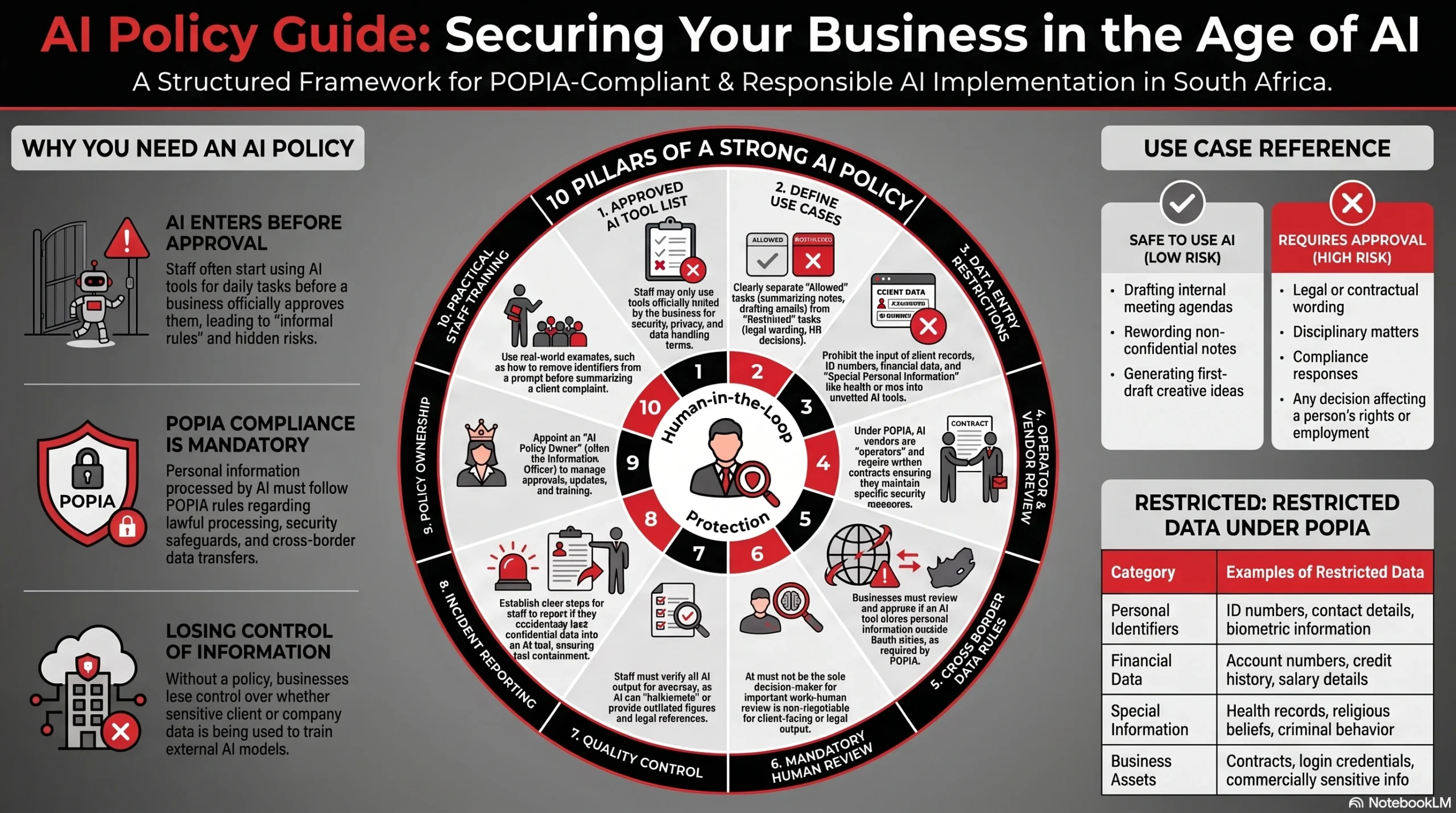
1. Approved AI Tools
Your policy should name the AI tools staff may use for work. This matters because different tools handle data differently. Some tools may use inputs to improve their services. Some may store data outside South Africa. Some may offer business or enterprise controls. Some may not be suitable for confidential work. Your policy should make one rule clear: Staff may only use approved AI tools for company work. Your business should approve a tool only after checking its terms, privacy position, data handling, security controls, user access options, and whether the tool is suitable for the intended work.
2. Approved and Restricted Use Cases
Your policy should explain what AI may be used for. For example, staff may be allowed to use AI for:
- Drafting internal emails
- Summarising non-confidential notes
- Preparing meeting agendas
- Rewording internal documents
- Generating first-draft ideas
- Creating checklists for internal review
- Cleaning up wording in low-risk content
Your policy should also explain where AI may not be used without approval. This may include:
- Legal wording
- HR decisions
- Disciplinary matters
- Financial approvals
- Pricing decisions
- Compliance responses
- Client-facing advice
- Final reports
- Safety-related decisions
Any decision that affects a person’s rights, access, employment, reputation, money, or legal position The practical rule is simple. AI may assist with work, but it should not silently become the person making the decision.
3. Personal Information and Confidential Data Rules
This is the most important section of the policy. POPIA defines personal information broadly. It includes information relating to an identifiable natural person and, where applicable, an identifiable existing juristic person. The definition includes items such as contact details, identifying numbers, location information, online identifiers, medical, financial, criminal, education, and employment history, biometric information, private correspondence, and views or opinions about a person. Your policy should state that staff may not enter the following into AI tools unless the tool and use case have been approved:
- Client records
- Customer details
- Employee records
- ID numbers
- Financial information
- Medical or health information
- Employment history
- Private correspondence
- Contracts
- Incident reports containing personal details
- Internal reports containing identifiable people
- Confidential operational information
- Login credentials
- Commercially sensitive information
POPIA also treats certain information as special personal information, including religious or philosophical beliefs, race or ethnic origin, trade union membership, political persuasion, health, sex life, biometric information, and certain criminal behaviour information. This type of information needs extra care and should not be entered into AI tools unless there is a clear lawful basis, approval, and appropriate safeguards. A practical policy rule would be:
- Do not paste personal, confidential, client, employee, financial, health, legal, contract, or incident-related information into an AI tool unless that tool and use case have been approved.
- Where AI can be used safely, staff should use the minimum information needed. They should remove names, contact details, reference numbers, addresses, and other identifiers where possible.
4. Operator and Vendor Review
Your AI policy should explain that staff may not approve AI vendors informally. Under POPIA, an operator is a person who processes personal information for a responsible party under a contract or mandate, without coming under the direct authority of that responsible party. POPIA says operators must process personal information only with the knowledge or authorisation of the responsible party and must treat personal information as confidential. POPIA also requires a written contract where an operator processes personal information for a responsible party, and that contract must require the operator to establish and maintain required security measures. This means your AI policy should include an approval process for tools that may process business or personal information. Before approving an AI tool, your business should check:
- What data the tool collects
- Where the data is stored
- Whether prompts or uploads are used for training
- Who can access the data
- Whether the tool offers business controls
- Whether there is a written agreement where needed
- Whether the tool can support your confidentiality and POPIA obligations
- Whether staff access can be managed or removed when needed
This turns AI adoption from a personal choice into a controlled business decision.
5. Cross-Border Data Transfers
Your policy should deal with data leaving South Africa. POPIA says a responsible party in South Africa may not transfer personal information about a data subject to a third party in a foreign country unless one of the listed grounds applies. These include adequate protection through law, binding corporate rules or agreement, consent, or specific contract-related grounds. Your policy should not expect staff to assess this on their own. A practical rule would be:
- Do not use an AI tool for personal information if the tool may process or store that information outside South Africa, unless the business has reviewed and approved the transfer basis.
- This does not mean every foreign AI tool is automatically prohibited. It means cross-border use must be reviewed before staff upload personal information.
6. Human Review and Final Responsibility
Your AI policy should make human review non-negotiable for important work. POPIA includes a rule on automated decision-making. It says a data subject may not be subject to a decision that results in legal consequences, or affects them to a substantial degree, if that decision is based solely on automated processing of personal information intended to profile that person, subject to limited exceptions and safeguards. POPIA also requires appropriate measures in certain cases, including an opportunity for the data subject to make representations and enough information about the underlying logic of the automated processing to enable them to do so. A practical AI policy should therefore say: AI output must be reviewed by a human before it is used externally or in any important business decision. This should apply to:
- Client communication
- Legal or contractual wording
- HR matters
- Disciplinary processes
- Financial decisions
- Compliance responses
- Safety-related work
- Reports used for formal decisions
Any output that affects a person or organisation in a meaningful way AI can support the work. A person must remain responsible for the final result.
7. Accuracy and Quality Control
AI output can be incomplete, outdated, or wrong. Your policy should not assume that AI output is correct. POPIA requires a responsible party to take reasonably practicable steps to ensure that personal information is complete, accurate, not misleading, and updated where necessary, having regard to the purpose for which it is collected or further processed. Your policy should tell staff how to check AI output before using it. For example:
- Check facts against reliable sources.
- Check names, dates, figures, and legal references.
- Check whether the answer fits the actual business context.
- Do not invent sources, results, case studies, or client outcomes.
- Do not use AI-generated wording if it changes the meaning of a policy, contract, report, or client instruction.
- Ask a manager, subject expert, or responsible owner to review higher-risk work.
This protects the business from using polished but unreliable content.
8. Incident Reporting and Breach Response
Your policy should tell staff exactly what to do if something goes wrong.
Under POPIA, where there are reasonable grounds to believe that personal information has been accessed or acquired by an unauthorised person, the responsible party must notify the Information Regulator and, subject to certain limits, the data subject. The notification must be made as soon as reasonably possible after discovering the compromise.
The Information Regulator also says the responsible party should notify the Regulator and affected data subjects as soon as it is reasonably sure a security compromise has occurred. The Regulator’s fact sheet says a security compromise does not have to be confirmed before it is reported, and an investigation does not need to be completed before reporting.
Your policy should include clear internal steps.
If staff enter restricted information into the wrong AI tool, share confidential content by mistake, or suspect that personal information has been exposed, they should:
- Stop using the tool or workflow immediately.
- Record what information was entered or exposed.
- Notify the Information Officer, Deputy Information Officer, manager, or assigned AI policy owner.
- Do not delete evidence without approval.
- Follow the internal incident response process.
- Wait for guidance before contacting clients, staff, vendors, or external parties.
The goal is fast containment, not blame.
9. Ownership and Accountability
Your AI policy needs an owner.
The Information Regulator states that public and private bodies are required to register their Information Officers, and that Information Officers are automatically appointed by virtue of their positions under PAIA and POPIA. It also notes that Information Officers must take up their duties only after being registered with the Regulator.
The Regulator also says Information Officer duties include encouraging compliance with the conditions for lawful processing of personal information, and that an Information Officer may develop a policy on how employees should implement those conditions.
In practice, your AI policy should name who owns AI approvals and policy updates.
That owner may be the Information Officer, Deputy Information Officer, operations manager, compliance lead, or another senior person with enough authority to control business processes.
The owner should be responsible for:
- Approving AI tools
- Approving higher-risk use cases
- Keeping a list of approved tools
- Reviewing vendor terms where needed
- Managing exceptions
- Coordinating training
- Updating the policy when systems or workflows change
- Handling incidents with the correct internal people
The Information Regulator’s guidance also says a Deputy Information Officer should have a reasonable understanding of POPIA and PAIA, as well as a reasonable understanding of the business operations and processes of the body. That is useful guidance for assigning practical ownership, because AI policy decisions need both compliance awareness and operational understanding.
10. Staff Training
A policy only works if staff understand it. Your AI policy should be supported by short, practical training. Staff do not need a technical lecture. They need clear examples from their actual work. Training should cover:
- Which AI tools are approved
- What staff may use AI for
- What information may never be uploaded
- How to remove identifiers from a prompt
- When human review is required
- How to check AI output
- How to report mistakes
- Who to ask before using AI in a new workflow
The training should use realistic business examples.
- Example: A staff member wants to summarise a client complaint. They should not paste the client’s name, contact details, account number, address, or full complaint history into an AI tool. If AI is allowed for that task, they should first remove identifying details and only use the minimum information needed to summarise the issue.
- Example: A manager wants help drafting a disciplinary letter. AI may be used only if the business has approved that use case, and the final document must be reviewed by the correct human decision-maker or professional adviser before it is used.
These examples make the policy easier to follow.
What a Good Starter Policy Looks Like
A good starter AI policy for a South African business should include:
- The purpose of the policy
- The tools staff are allowed to use
- The work AI may be used for
- The work AI may not be used for without approval
- The categories of data staff may never upload without approval
- Rules for personal information and confidential information
- Rules for special personal information
- Vendor and operator approval requirements
- Cross-border data transfer review requirements
- Human review requirements
- Accuracy and fact-checking rules
- Incident reporting steps
- The person or role responsible for approvals and updates
- Training requirements
This is enough to move from informal AI use to controlled AI use. The policy does not need to be long. It does need to be specific, usable, and connected to the way your business actually works.
Final Thought
AI can help staff work faster, but speed without control creates risk. A practical AI policy gives your team a clear way to use AI while protecting client information, employee information, confidential business data, and decision quality. The best policy is not the most complicated one. It is the one your team can understand, follow, and apply in real workflows. If your staff handle client communication, reports, approvals, incidents, HR records, job updates, compliance documents, or operational dashboards, your AI policy should reflect those workflows directly. Repautomate helps South African businesses put practical controls around AI use before it creates risk. That includes AI usage policies, workflow-specific rules, approval paths, staff guidance, and implementation support built around your actual operations. Contact Repautomate for a practical AI readiness review and a policy framework that fits the way your business already works. Sources:
- https://www.justice.gov.za/legislation/acts/2013-004.pdf “Protection of Personal Information Act 4 of 2013”
- https://inforegulator.org.za/2025/08/19/fact-sheet-handling-of-security-compromises/ “FACT SHEET: HANDLING OF SECURITY COMPROMISES”
- https://inforegulator.org.za/popia/ “Who makes an application to process Special Personal Information?”